
Why women must lead climate and health solutions as we head towards COP31
This article was written by Keziah Bennett-Brook, Emily Nelson and Laura Downey and published by Melissa Sweet, Croakey Health Media on 8 May 2026. Licensed by Copyright Agency. Do not copy this work without permission.
Women and Indigenous communities know how to reduce climate harms and build resilience. And they need to be recognised, resourced and respected to lead on climate and health solutions, according to the authors below, who report from the recent Women Deliver 2026 conference.
As the climate crisis deepens, its impacts are increasingly felt – not in abstract metrics, but in bodies. We see this through heat stress, hunger, chronic and infectious disease, and the physical, mental, and emotional toll of caring for ourselves and others during and after times of great strain.
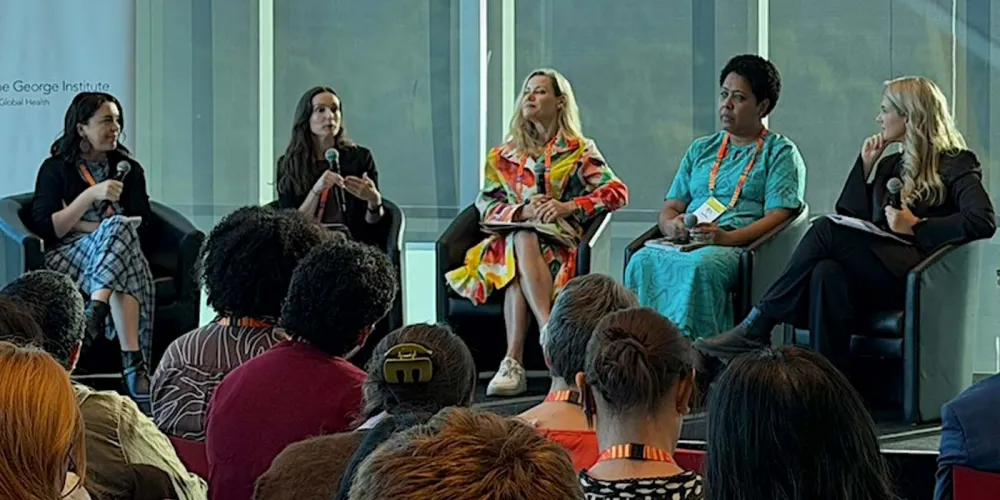
This was a clear through‑line emerging from a recent panel discussion on women, climate and health held as a side event to the Women Deliver conference, where speakers repeatedly brought the conversation back to the very real impacts that climate change is already having on people’s lives, and especially the lives of women on the frontlines.
This grounding was powerfully articulated by Ilisapeci Masivesi, Director of Programmes, Impact and Partnerships at Oxfam Pacific, who urged us to move away from treating climate as a distant, securitised threat and instead understand it as something experienced through our bodies, particularly the bodies of women, carers and Indigenous peoples.
One of this article’s authors, panellist Keziah Bennett-Brook, Director Guunu-maana First Nations Program, The George Institute for Global Health, reflected that climate change is not gender‑neutral and certainly isn’t culturally neutral.
She highlighted that its health impacts accumulate where power, resources and decision‑making are already constrained, yet policy and funding responses do not reflect this reality.
From security to sovereignty
Much of the dominant climate discourse remains framed around “security” and those most “vulnerable” being framed as beneficiaries of programming, rather than active leaders and decision makers. We see this through a focus on national security, food security, energy security.
While these frames can be politically expedient, they risk flattening lived experience and overlooking who ultimately bears the costs of climate disruption.
Several panellists pushed instead for a shift towards sovereignty. This is not just a semantic shift, but a substantive one that demands we ask different questions, such as ‘Who controls resources?’, ‘Who decides priorities?’ and ‘Whose knowledge counts?’ in the fight for climate justice.
For Indigenous communities, sovereignty is not a new concept but a lived and ongoing struggle. Climate change intersects with this history, amplifying dispossession while also revealing the deep resilience embedded in Indigenous governance systems.
Bennett-Brook reflected that Indigenous knowledge systems do not separate climate, Country, health care and governance, but instead understand these as relational and interdependent. These systems are not just culturally significant but are essential to climate‑resilient health futures.
Women’s health is climate health
Women experience climate impacts differently, and often more severely. Another of this article’s authors, panellist Laura Downey, Associate Professor, Health Systems, reflected on increased exposure to heat while working, heightened food insecurity, rising rates of gender‑based violence during climate disasters, and the long‑term burden of caring for others whose health deteriorates under climate stress.
The increasing burden of non-communicable diseases (NCDs) globally is a significant public health concern. In countries of the Southeast Asia-Pacific region, NCDs account for up to 86 percent of all deaths, among which diabetes and cardiovascular disease are responsible for up to one half.
Chronic conditions including diabetes, cardiovascular disease, cancer and respiratory illness are increasingly prevalent across Southeast Asia and Pacific, and are exacerbated by climate change through disrupted food systems, reduced access to care, physiological heat strain on the body, and repeated environmental shocks.
These health burdens fall disproportionately on women, particularly those managing the food and water needs of their households, caring for elders and children, and trying to maintain health in increasingly inhospitable conditions.
Yet women’s health is still too often treated as a downstream issue, rather than a central pillar of climate responses.
Downey highlighted that this is compounded by the persistent lack of disaggregated data. When health and climate data are not broken down by sex, gender, Indigeneity, disability or geography, whole groups of people effectively disappear from policy view.
What isn’t counted isn’t funded, and what isn’t funded isn’t prioritised for protection.
Embedding governance and leadership
A recurring frustration voiced during the panel was the way communities, particularly Indigenous and marginalised communities, are positioned within climate and health systems.
They are routinely consulted, occasionally targeted, yet rarely recognised as agents of change in shaping decisions from the outset or leading implementation.
There is a profound difference between being a beneficiary of a program and being part of its governance. Too many climate‑health initiatives still rely on short‑term, externally designed projects that are piloted in communities and withdrawn once funding cycles end.
This project‑based approach may satisfy accountability frameworks, but are void of accountability to communities themselves. Panellists emphasised how such models do little to build lasting capacity or resilience.
Programs such as the Australian Government funded RESist‑NCD Program, led by The George Institute for Global Health, demonstrate an alternative. By embedding non‑communicable disease prevention and care within primary health systems, and by intentionally integrating gender equality, disability and social inclusion alongside First Nations leadership, the program recognises primary healthcare as essential climate infrastructure.
Crucially, gender equality, disability and social inclusion and First Nations inclusion are not treated as downstream considerations or parallel work-streams. They are embedded across the design, delivery and governance of the program, thereby shaping priorities, strengthening service delivery and shifting how success is defined.
This approach acknowledges that climate impacts surface first in primary care settings, and that adaptation is either enabled or constrained by who holds decision‑making power within health systems.
In this framing, health systems are not simply sites of treatment, but frontline spaces where climate exposure, care burdens and resilience intersect. Programs designed in this way are better equipped to respond to the compounding risks experienced by women, Indigenous peoples and other structurally marginalised groups, particularly in climate‑affected settings.
As the panel agreed, true equity does not come from targeting communities more precisely. It comes from governing differently. Diversity and inclusivity should be the governance norm, not the outlier.
Changing funding systems
Perhaps the most pointed discussion came when panellists turned to funding. There was a shared recognition that many of the barriers to community leadership are structural, embedded in grant design, reporting requirements and the administrative burden placed on small organisations.
Drawing on her experience working with governments, global institutions and philanthropic actors, Amanda Ellis, Senior Director of Global Partnerships and Networks, Julie Ann Wrigley, Global Futures Laboratory, and Executive Director, Julie Ann Wrigley Global Institute of Sustainability, at Arizona State University, spoke directly to the persistent disconnect between global climate ambition and the place of health and gender within climate action.
Despite overwhelming evidence that climate change is a public health crisis, health is still too often treated as an outcome to be protected, rather than a central organising principle of climate policy. This gap is not simply a matter of awareness, as Ellis emphasised, it reflects how climate risks are framed and valued within policy systems that continue to privilege economic and technical indicators over human wellbeing.
If we are serious about climate justice, funding must move closer to communities, not merely through sub‑contracts or advisory roles, but through direct access to resources and decision‑making power. This requires funders and institutions to relinquish some control, reform exclusionary application processes, and meaningfully recognise local leadership and community expertise.
It also requires researchers and intermediaries to push back against funding structures that privilege scale over relevance, speed over trust, polished proposals over community needs, and technical outputs over long‑term system change.
As several panellists noted, this is uncomfortable work, but it is necessary if climate responses are to be credible and effective.
Looking to COP31
As global attention turns towards COP31, these conversations feel increasingly urgent.
International climate negotiations continue to acknowledge the importance of women’s and Indigenous leadership in principle, while often failing to reflect this in practice or financing.
If COP processes are to deliver meaningful outcomes, they must move beyond symbolic inclusion and invest in locally governed, culturally grounded health systems that centre women’s leadership. This is not a matter of charity or representation, but of effectiveness.
As Laura Downey highlighted during the panel discussion, putting women in positions of power to drive forward climate solutions is not just morally commendable, but good bang for buck – narrowing the gender health gap is one of the strongest levers for social and economic prosperity, everyone benefits.
Climate solutions that ignore women’s bodies, labour and authority are incomplete by design and unlikely to be fit for purpose or endure.
The panel closed with a clear message that climate change is already reshaping health, care and survival at community level.
In a region where climate change is multiplying health inequities and threats, women and Indigenous communities already hold the knowledge to reduce harm and build resilience. What is needed is true recognition, resourcing, and respect for them to lead this charge.
As we head towards COP31, public health voices have a critical role to play in keeping this reality front and centre, and in insisting that climate action starts where impacts are felt most acutely, in bodies, communities and everyday care.
Stay connected and updated
Subscribe to our mailing list for the latest news, events, and updates in health research.


