
Women Deliver 2026: Connecting Climate, Chronic Disease and Gender Equality
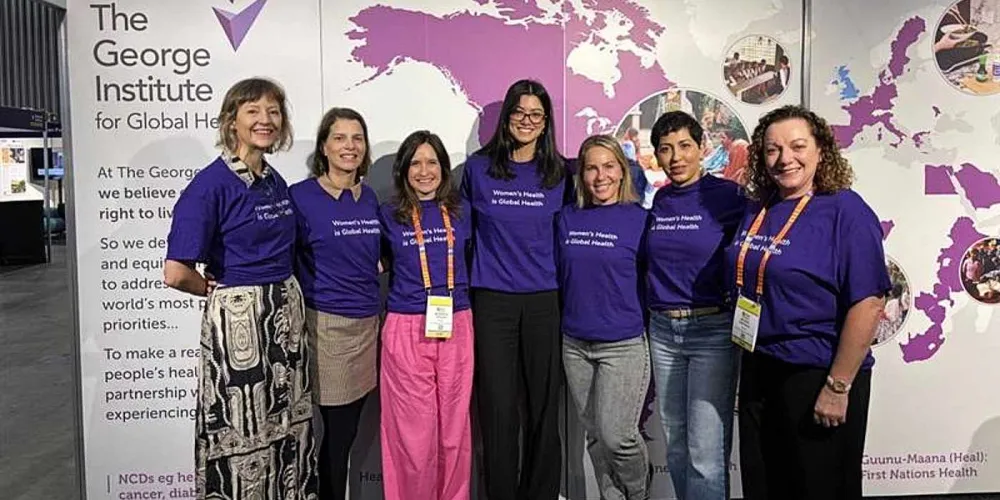
Last week at Women Deliver 2026 in Melbourne, The George Institute for Global Health brought a clear message to a global audience: women’s health cannot be separated from climate change or noncommunicable diseases (NCDs). Instead, these issues are deeply interconnected and addressing them together is essential to achieving health equity.
Throughout the conference, The George Institute engaged with partners, advocates and funders to highlight the links between climate, health and gender inequality, and to share practical, evidence-based solutions that can be scaled globally.
A convergence shaping women’s health
Across the Asia-Pacific region and globally, three powerful forces are converging: climate change, rising rates of NCDs, and persistent gender inequality.
NCDs such as heart disease, diabetes, stroke and cancer are now the leading cause of death among women worldwide, yet remain under-recognised in women’s health agendas. At the same time, climate change is intensifying health risks, from heat exposure to air pollution and food insecurity, all of which worsen chronic diseases and disproportionately affect women.
In the Pacific, for example, women face some of the world’s fastest rising burdens of NCDs alongside accelerating climate impacts. These overlapping pressures are compounded by structural inequities, including limited access to care and reduced decision-making power.
Climate change is a women’s health issue
A core focus of The George Institute’s presence at Women Deliver was reinforcing that climate change is not only an environmental issue; it is a health issue, and a gendered one.
Climate-related risks are already reshaping women’s health outcomes:
- Extreme heat is linked to poorer pregnancy outcomes and increased cardiovascular and kidney disease.
- Air pollution contributes to rising rates of heart and lung disease.
- Food and water insecurity exacerbates conditions such as diabetes and hypertension.
- Climate disasters disrupt essential health services, including both chronic disease care and reproductive health.
Women are also more likely to be affected by climate events-making up 80% of displaced people and facing higher mortality in disasters-due to social roles and inequalities.
Rethinking women’s health beyond reproduction
The George Institute used opportunities at Women Deliver to challenge a long-standing gap in global health: women’s health is too often limited to reproductive care.
Instead, a life course approach is needed—one that addresses prevention, early detection and long-term management of NCDs across all stages of life.
Failing to address chronic disease not only affects health outcomes, but also limits women’s ability to work, learn and participate fully in society, reinforcing cycles of inequality.
Showcasing solutions that work
At its exhibition booth and side events ‘Beyond the Male Default: The Future of Women’s Health’ and ‘Climate Justice at the Heart of Women's Health’, The George Institute showcased community-led, gender-responsive models already delivering impact-particularly across the Pacific.
These include:
- RESist NCD which strengthens community-based prevention and care for hypertension and diabetes through culturally grounded approaches.
- NIHR Global Health Research Centre for NCDs and Environmental Change co‑led by The George Institute examines how environmental change affects chronic disease and pregnancy outcomes and co-designs practical solutions.
These initiatives demonstrate that integrating climate adaptation, NCD prevention and primary health care is both feasible and effective, and ready to be scaled with the right investment.
Building momentum for global action
The message is clear: investing in women’s health is one of the most powerful levers for stronger, more resilient societies.
By tackling climate change, chronic disease and gender inequality together, countries can not only improve health outcomes, but also strengthen economies, communities and future resilience.
As conversations continue beyond Women Deliver and into global policy forums, The George Institute is calling for one central shift: put women’s health at the heart of climate and health action. The team is eager to maintain momentum and invites people to connect to continue the dialogue as discussions on these interconnected agenda items evolves, ahead of pre-COP in Fiji in October, the UN Climate Change Conference (COP31) in November, and the UN High-Level Meeting on Universal Health Coverage in September next year.
Stay connected and updated
Subscribe to our mailing list for the latest news, events, and updates in health research.
