Crunch time for Health Star Ratings as voluntary phase nears end
Date published: Node Type: Media release


Australia and New Zealand’s Health Star Rating system is a vital tool for promoting healthier food choices and improving the food supply. The fact that its application has been voluntary to date, however, means consumers have not been able to compare ratings of similar products to help them sort marketing claims from nutritional information.
Allowing Health Star Ratings to be selectively applied by manufacturers also gives limited incentive to improve the nutritional profile of lower-rating products. Given the mounting evidence linking poor diets with rising rates of obesity and diseases including heart disease, cancers, and type 2 diabetes, mandating the Health Star Rating system will give Australian consumers the information they need to make healthy food choices for themselves and their families.
Making Health Stars mandatory will improve the scheme for consumers and incentivise food manufacturers to offer healthier products. There is broad support from public health and consumer groups for mandating the system.
Putting simple, graphics-based nutrition labels on the front of packaged foods is recognised by the World Health Organization as an effective and cost-effective public health tool to address diet-related disease. Front-of-pack nutrition labelling has been adopted by more than 50 countries. Stars are one of the methods recognised by WHO as an effective approach to FOP labelling.
Introduced in 2014, the Health Star Rating has become a well-recognised and trusted tool for consumers in Australia and New Zealand to make healthier choices for themselves and their families.
Health Star Ratings work by assigning packaged foods a score from 0.5 to 5 stars. The system deducts points for high energy, saturated fat, sodium and sugar content, and awards points for fibre, protein and fruit, nut, vegetable and legume content. The resulting overall rating makes it easy for time poor consumers to compare the healthiness of similar products in the supermarket, and identify healthier options.
Health impacts of diet-related disease to the Australian population include:
• A 220% increase in type-2 diabetes over the last two decades[1]
• The proportion of Australian adults living with overweight and obesity increased from 57% in 1995 to 66% in 2022[2]
• Overweight and obesity overtook smoking in 2024 to be the leading risk factor for poor health[3]. Dietary risks separately accounted for a further 4.8% of the burden of disease[3]. It has been estimated (2015) that the total annual costs of obesity in Australia are $8.6 billion[4]
A survey of 2,000 Australians in 2023 found 82% of adults agreed the Health Star Rating should be included on all packaged foods[5]. Further, 66% agreed that compulsory labelling would make Health Star Ratings more useful and 65% agreed it would help to simplify their decision making[6].
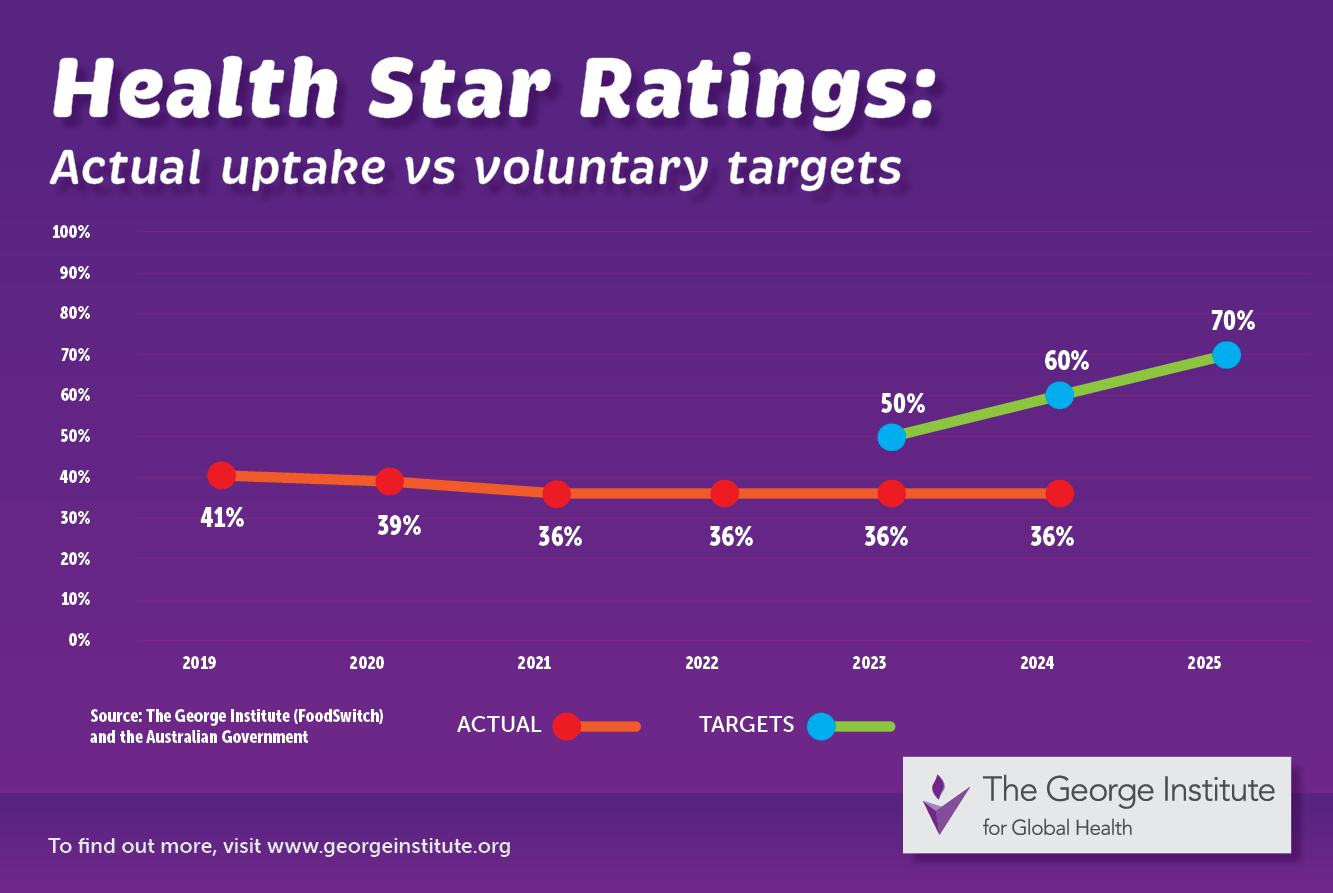
A five-year review of Health Star Ratings in 2019 found that the system performed well overall and should be continued[7]. Government monitoring, as well as the independent, annual monitoring conducted by The George Institute through its FoodSwitch program, show that uptake has stagnated at around one-third of products in Australia.
The latest FoodSwitch data (2024) confirmed only 36% of products showed a Health Star Rating[8]. From this position, the industry will not reach the final voluntary target of 70% by November 2025.
History shows that widespread and rapid food labelling changes are feasible when required by law. In the same period that the Health Star Rating system has been operating, over 90% of product packages were updated to display a Country-of-Origin Label in Australia within a few years of this being made mandatory[9]. This shows that the cost to redesign or repackage to meet new labelling requirements cannot be the primary reason manufacturers have not displayed the Health Star Ratings on more foods.
The Health Star Rating system is a joint initiative by the Australian, state and territory governments and New Zealand Government. Food Ministers in Australia and New Zealand are responsible for all decisions about the Health Star Rating system.
Health Star Ratings are an example of an effective tool to support consumers’ health and encourage manufacturers to improve the healthiness of packaged foods and beverages. Once Health Star Ratings become mandatory, it will be time to look at other improvements to further strengthen the system.
References
1. Diabetes Australia. 2023 Snapshot: Diabetes in Australia. 2023; Available from: https://www.diabetesaustralia.com.au/wp-content/uploads/2023-Snapshot-Diabetes-in-Australia.pdf.
2. Australian Institute of Health and Welfare. Overweight and obesity. 2024; Available from: https://www.aihw.gov.au/reports/overweight-obesity/overweight-and-obesity.
3. Australian Institute of Health and Welfare. Australian Burden of Disease Study 2024: Leading risk factors. 2024; Available from: https://www.aihw.gov.au/reports/burden-of-disease/australian-burden-of-disease-study-2024/contents/interactive-data-on-risk-factor-burden/leading-risk-factors.
4. PwC Australia. Weighing the cost of obesity: a case for action. 2015; Available from: https://www.pwc.com.au/pdf/weighing-the-cost-of-obesity-final.pdf.
5. Ilchenko, E., R. Jinnette, and B. Morley, Shape of Australia 2023 Survey: Final Report. 2024, Cancer Council Victoria.
6. VicHealth, Commissioned research. 2025.
7. mpconsulting. Health Star Rating System Five Year Review Report. 2019; Available from: http://www.healthstarrating.gov.au/internet/healthstarrating/publishing.nsf/Content/D1562AA78A574853CA2581BD00828751/$File/Health-Star-Rating-System-Five-Year-Review-Report.pdf.
8. The George Institute for Global Health. Mandatory Health Star Ratings a must after 10 years of food industry inaction. 2024; Available from: https://www.georgeinstitute.org/news-and-media/news/mandatory-health-star-ratings-a-must-after-10-years-of-food-industry-inaction.
9. Jones, A., et al., Voluntary versus mandatory food labels, Australia. Bull World Health Organ, 2024. 102(10): p. 691-698.