
Progress by Design: Roundtable on Implementing Team-Based Primary Care
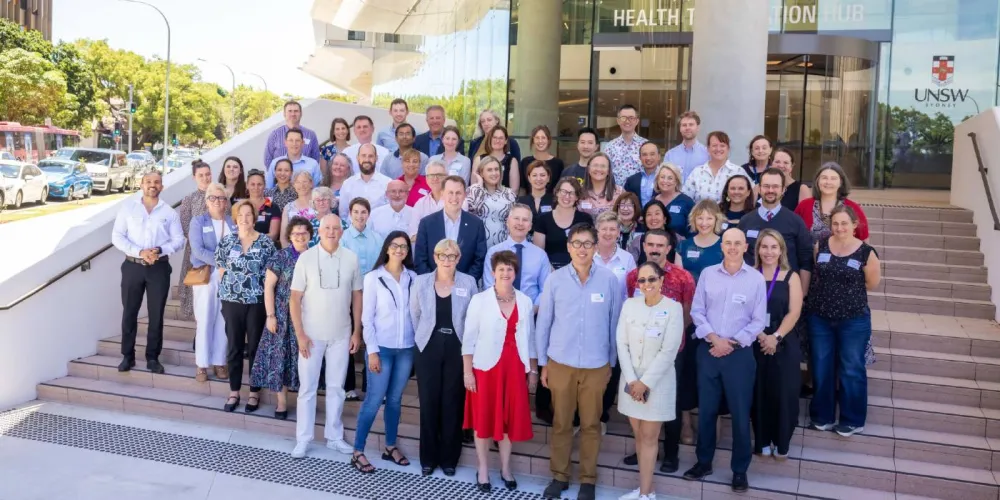
Leaders in primary care, policy, and service innovation came together at the Health Translation Hub UNSW for a full-day roundtable focused on accelerating Australia's shift toward team-based, integrated models of primary care. The event opened with a Welcome to Country from Uncle Ron Timbery, who reflected on traditions of knowledge-sharing and respect of the Bidjigal and Gadigal peoples.
Convened by The George Institute for Global Health and joint hosts Inala Primary Care Brisbane, Healthicare Western Sydney, Next Practice Deakin ACT, International Centre for Future Health Systems, UNSW Sydney, the meeting brought together practitioners already pioneering multidisciplinary models of care. Speakers highlighted that while national reviews consistently call for reform, few describe how to implement change at the frontline.
A patient story grounded the discussion in the lived experience of navigating fragmented care and underscored the value of coordinated, multidisciplinary, patient centred care.
Department of Health, Primary Care and Workforce Reviews Taskforce Assistant Secretary- Nick Morgan outlined the Australian Government's emerging reform directions, including work on blended funding models, digital infrastructure, scope-of-practice improvements and clinical governance arrangements to better support collaborative care.
Professor Rosemary Calder presented case studies demonstrating how innovative practices are already delivering integrated care through redesigned workflows, data-driven approaches and purpose-built environments - highlighting both the potential and challenges of scaling such models nationally.
Approximately 60 participants including practice managers, nurses, administration staff, GPs, consumer representatives, and allied health professionals from metropolitan, regional, and remote experience were invited to share practical insights, challenges and strategies that have already or would in future enable them to progress toward more comprehensive, patient-centred care. Facilitators used creative methods -including mixed tables and hands-on activities - to help participants think beyond traditional constraints and imagine new ways of working.
Key enablers identified in the discussion
There was a growing appetite for a movement away from GP-dependent care, towards GP-led care, which leverages the scope and strengths of a multi-disciplinary team supported by strong clinical governance and organisational leadership.
Across presentations and table conversations, several enablers of successful team-based primary care emerged:
- Culture and governance anchored in patient and community needs
A shared culture that puts patient and community needs first, supported by strong clinical governance so all staff can work to full scope while ensuring safety, quality, and responsiveness to place. - Purposeful workforce and practice design
GP-led but not GP-dependent structures that use the full skillset of nurses, allied health, administrative staff, and others; clear role delineation; redesigned workflows, and practice environments that naturally support multidisciplinary teamwork. - Supportive funding, data, and digital Infrastructure
Blended and flexible funding arrangements paired with integrated digital and data systems that enable information sharing, decision support, quality improvement, and care organised around patient needs rather than fee-for-service constraints. - Adaptive learning, change leadership, and system enablers
Strong change management capabilities, team learning, and supportive system settings that cultivate sustainable practice models, career pathways, and an overall environment that encourages innovation and continuous improvement.
Participants were invited to continue to participate in next steps. Insights gathered throughout the roundtable and from subsequent participant involvement will inform a forthcoming report designed to guide policy and sector action in early 2026.
Stay connected and updated
Subscribe to our mailing list for the latest news, events, and updates in health research.
