Webinar series: Digital health & AI readiness in primary care systems
A Joint Initiative of The George Institute for Global Health and WHO South-East Asia Regional Office (SEARO)
Background
Primary healthcare (PHC) is the foundation of equitable health systems, especially in low- and middle-income countries (LMICs) of the WHO SEARO. Despite sustained investment, PHC delivery continues to face challenges such as fragmented services, workforce shortages, uneven adoption of innovations, and persistent inequities in access and outcomes. Digital health and artificial intelligence (AI) offer significant potential to strengthen PHC systems. Early impact of these technologies is demonstrated through improvements in decision support, predictive analytics, and workflow optimisation in resource-constrained environments. Yet, much of this promise remains unrealised because evidence is scarce and, where it exists, rarely translated into actionable policy and practice, leaving innovations largely confined to pilots or fragmented initiatives.
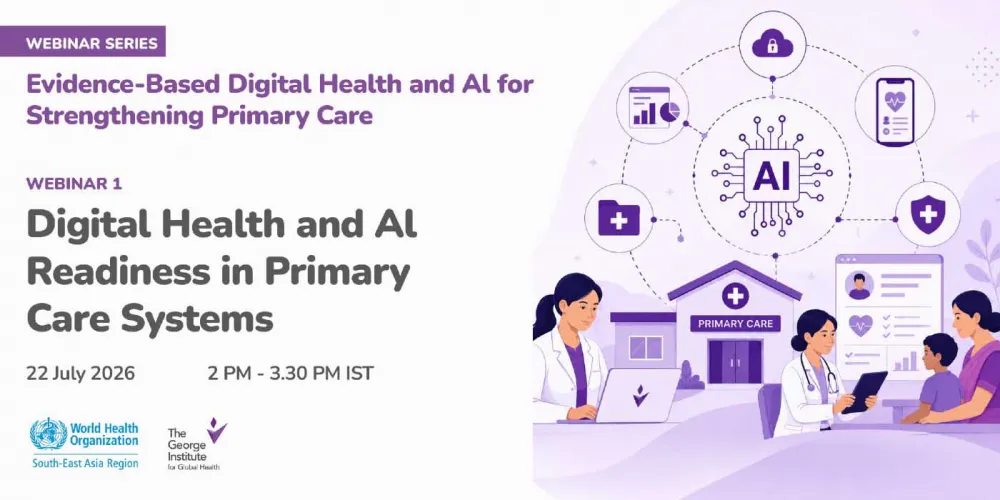
Webinar 1: Evidence-based digital health and AI for strengthening primary care in the South-East Asia Region
Rationale
The rationale for this webinar series is to bridge the gap between evidence generation and policy adoption. Digital health and AI interventions are not transformative on their own; their impact depends on contextualisation, governance, and integration into existing health system structures. LMICs in SEARO face unique constraints such as limited infrastructure, variable digital literacy, and diverse sociocultural contexts, that demand tailored approaches. Evidence must therefore be synthesised, critically appraised, and translated into guidance that policymakers, programme managers, and frontline workers can use.
Purpose and Objectives
This series aims to equip policymakers, programme managers, and frontline health workers across the Region with synthesised evidence and practical tools to design, implement, and scale Digital health and AI interventions within primary care. Each session translates current evidence into contextualised, actionable guidance tailored to the policy and implementation realities of SEARO member states.
By the end of this series, participants will be able to:
- Assess Digital Health and AI readiness using established WHO frameworks and identify system-level priorities for strengthening primary care digital foundations
- Critically appraise evidence on AI-enabled clinical decision support and telemedicine, including usability, safety, and real-world implementation considerations
- Identify governance, data, and workforce enablers required for the safe and equitable deployment of Digital health solutions in low- and middle-income country contexts
- Apply evaluation frameworks, financing models, and regulatory pathways to design scalable, evidence-based implementation strategies for national Digital health programmes
Target audience
This series is intended for professionals working at the intersection of health systems, Digital health, and policy in the South-East Asia Region, including:
- Policymakers and programme managers from health ministries
- Primary care practitioners and implementers
- Public health researchers and academics
- Representatives of international organisations and development partners
Expected outcomes
- A clear understanding of Digital health and AI readiness frameworks and system-level priority actions for strengthening digital foundations in primary care
- The ability to evaluate AI-enabled clinical decision support and telemedicine solutions against safety, usability, and real-world implementation criteria
- An understanding of governance frameworks, data standards, and workforce capacity requirements for the safe and equitable deployment of Digital health solutions in low- and middle-income settings
- The knowledge to design or strengthen implementation plans incorporating evidence-based financing, regulatory pathways, and scale-up strategies for Digital health in primary care
Webinar 1: Evidence-based digital health and AI for strengthening primary care in the South-East Asia Region
This session focuses on assessing Digital health maturity using WHO frameworks, identifying system level gaps, understanding readiness for AI integration in primary care, and prioritising actions for strengthening digital foundations
Date and time – 22nd July 2026, 14:00 (2:00 PM) IST
Duration: 90 Minutes
Webinar 2: AI & Digital Solutions at the Point of Care
This session focuses on evaluating the clinical effectiveness of AIenabled CDSS and telemedicine, understanding usability and safety considerations, analysing realworld implementation challenges, and identifying design principles and best practices for frontline adoption.
Date and time (tentative) – 23rd September 2026, 14:00 (2:00 PM) IST
Duration: 90 Minutes
Webinar 3: Workforce, data, and governance for digital health
This session focuses on defining digital competencies for the PHC workforce, understanding data governance and interoperability standards, identifying risks such as bias and safety, and develop systemlevel enablers for safe AI deployment.
Date and time (tentative) – 25th November 2026, 14:00 (2:00 PM) IST
Duration: 90 Minutes
Webinar 4: From evidence to scale: evaluation, financing, and implementation
This session focuses on evaluating financing and sustainability models for Digital Health and AI in primary care, understanding regulatory pathways in LMICs, applying evaluation frameworks and study designs, identifying outcome measures beyond accuracy, and translate national strategies into scalable, evidencebased implementation models.
Date and time (tentative) – 27th January 2027, 14:00 (2:00 PM) IST
Duration: 90 Minutes