
Integrating sex and gender in cancer research: Why and how to advance more equitable practice
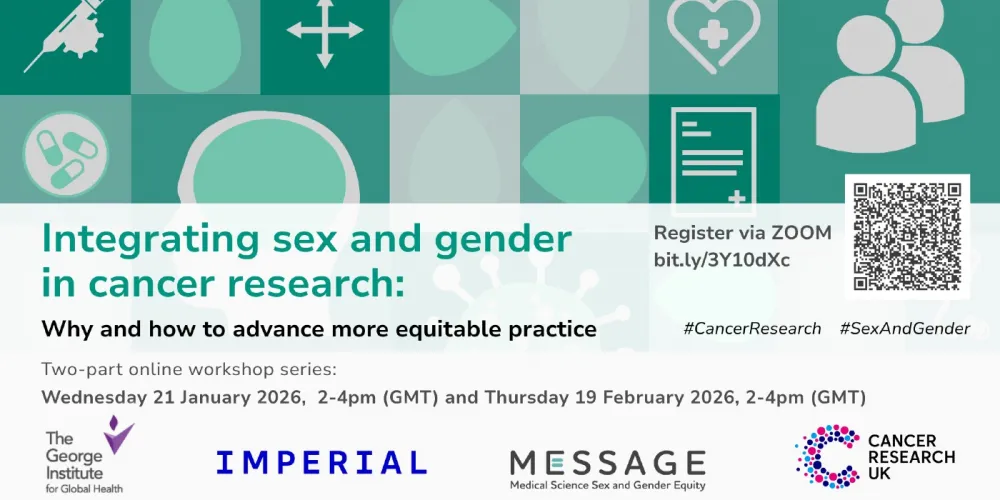
Sex and gender influence cancer biology, risks, and outcomes, as well as one’s experiences across the full continuum of care, including quality of life with and beyond a cancer diagnosis. Yet these dimensions remain under-studied and poorly integrated in cancer research.
The George Institute for Global Health, the Medical Science Sex and Gender Equity Project (MESSAGE), Imperial College London and Cancer Research UK are convening a new two-part virtual workshop series to bring researchers, funders and policymakers together to explore why sex and gender matter in cancer research—and how to integrate them in practice.
The series will combine case studies, practical methodological guidance, moderated panel discussions and interactive breakout sessions to support more rigorous, equitable, and impactful cancer science. Please find details of each workshop following:
Workshop 1 – Understanding Why Sex and Gender Matter in Cancer Research
- Overview of biological and sociocultural determinants of sex and gender variability in cancer
- Case studies illustrating impact across cancer types and research domains
- Discussion: Common challenges and misconceptions in integrating sex and gender analyses
Workshop 2 – Operationalising Sex- and Gender-Responsive Cancer Research
- Practical guidance on study design, data collection, and analysis
- Integrating sex and gender in translational, clinical, and implementation research
- Policy and funding perspectives: enabling environments for equitable science
- Discussion: Pathways for collaboration, training, and disseminati
For further information, please contact Prof Ophira Ginsburg (o.ginsburg@imperial.ac.uk)